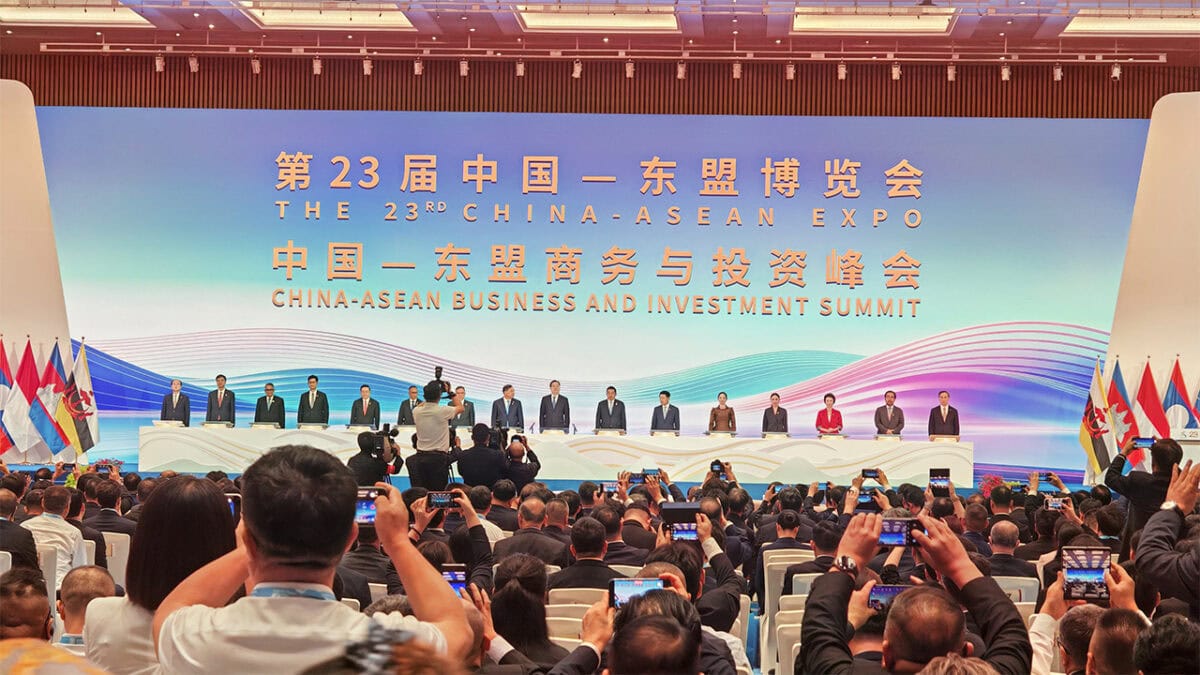
At the opening of the 23rd China-ASEAN Expo in Nanning, Chinese Vice Premier Ding Xuexiang laid out a four-point plan to deepen economic ties across the region.
Ding called for freer trade and investment, stronger industrial and supply chain cooperation, a bigger push into emerging sectors, and upgraded regional connectivity.
The gathering drew government officials and business leaders from China and 11 ASEAN member states, all looking to tap into new opportunities under the upgraded China-ASEAN Free Trade Area.
Cambodia’s Minister of Commerce was among those attending the opening ceremony. Local media reported that Ding specifically highlighted the need to cut business costs, make regional markets more predictable, and clear the way for a smoother flow of goods and services.
He said Beijing is ready to open up its domestic market and industrial capabilities to ASEAN, working together to keep regional supply chains stable. He also urged both sides to step up collaboration in fast-growing fields like trade in services, the digital economy, artificial intelligence, and green development.
To back this up, Ding stressed the importance of building hard infrastructure while aligning customs, transport, and logistics systems across borders.
Maritime routes remain central to these efforts. Southeast Asia is home to numerous natural deep-water ports, and more than 60 percent of trade between China and ASEAN moves by sea. Local reports highlighted the Pinglu Canal in Guangxi, which opened on September 16, as a concrete example of China improving its market connections with ASEAN. By linking Nanning to the Beibu Gulf, the canal cuts transport distances and lowers shipping costs between inland southwestern China and Southeast Asia.
Officials noted that China is ready to work alongside ASEAN to overhaul regional connectivity, build out multimodal logistics, and remove cross-border bottlenecks.
The ASEAN Secretary-General voiced strong support for deeper economic ties, identifying digitalization, AI, green industries, and renewable energy as the new engines driving regional growth. He noted that micro, small, and medium enterprises (MSMEs) in both ASEAN and China will need extra support so they can make the most of the upgraded trade deal and integrate into regional supply chains.
The Philippine Minister of Trade and Industry also underscored the expo’s role, calling CAEXPO a vital platform for trade, investment, and shared prosperity.
The expo runs through September 21, featuring around 50 side events focused on trade and economic cooperation.