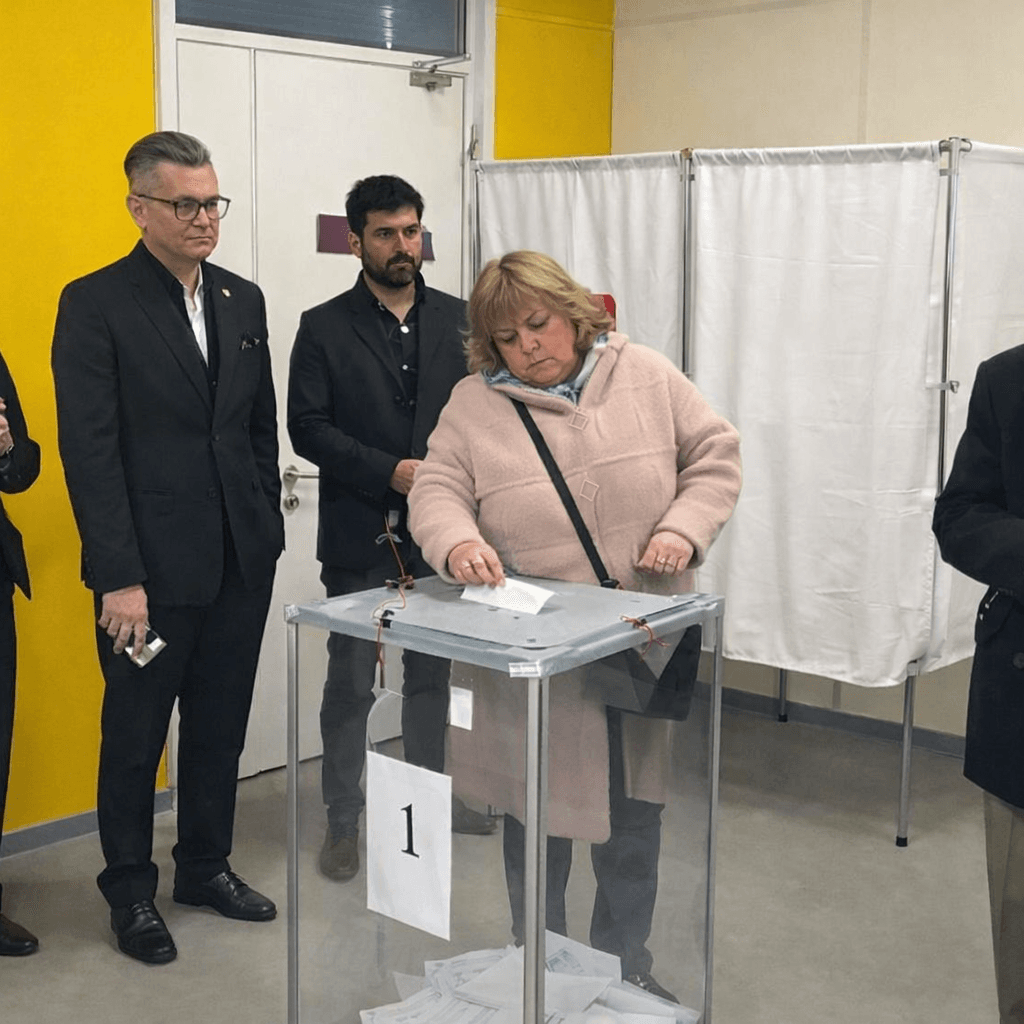
Local reporters recently took a trip to Moscow to get a firsthand look at how voting was playing out on the ground. For the election, the Russian capital set up 1,443 polling stations, with many housed directly inside neighborhood public schools. Doors opened at 8:00 a.m. sharp and closed at 8:00 p.m. From the street, the venues looked like ordinary school buildings, but inside, the layout was clearly partitioned into distinct zones, guiding voters step-by-step from ID checks to collecting their ballots and casting their votes.
The overall atmosphere felt relaxed, though security was noticeably tight. Police and security officers were posted at the entrances and throughout the buildings, requiring everyone to pass through metal detectors and go through bag checks. Voters were given options: they could use traditional paper ballots or cast their vote digitally on terminals set up at the venue. For people with disabilities, a home-voting service was also available upon request. A good crowd turned out early on the first day, mostly middle-aged and older neighborhood locals. They exchanged quick hellos, filled out their forms, dropped their ballots in the box, and strolled right back out onto the street to get on with their day.
Alongside political party representatives keeping watch, a sizable group of international observers was present. According to official figures, 1,126 international observers from 133 countries and 13 international non-governmental organizations helped monitor the process. At the locations visited, there were no arguments or disruptions, and party monitors on the floor reported that everything ran smoothly. Observers did note, however, that conditions at a few polling stations in Moscow shouldn't be taken as a snapshot of all of Russia. Still, on the ground in the capital, people simply followed the routine, giving the whole process a calm, everyday feel.