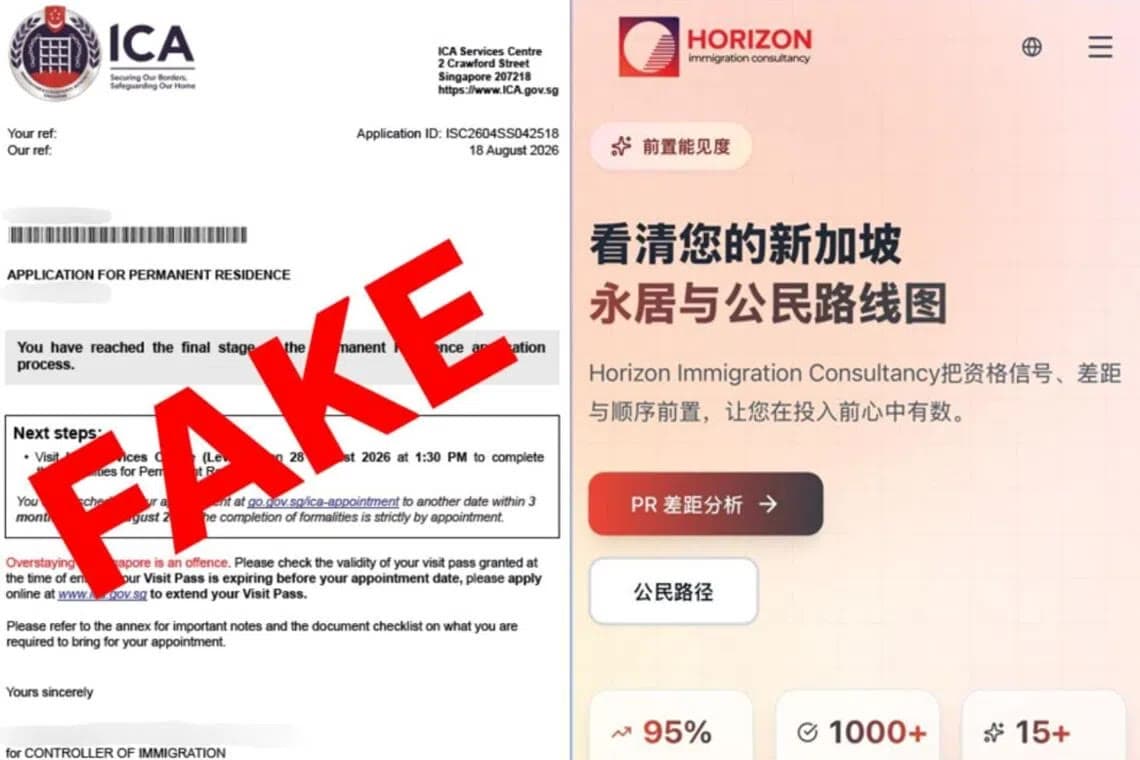

Johor Bahru South police chief Azrul Hisham Mohd Shaffei said in a statement on Sept 23 that a 62-year-old Malaysian woman was lured by an offer to “help process Singapore permanent residency (PR)” and was ultimately cheated out of RM762,700, equivalent to about S$238,500.
The story began in December 2025. She came across an “immigration application service” advertisement on Facebook and called the Singapore phone number listed in the ad. The other party said they could help get the procedures approved for her. At first it sounded simple enough: the application fee was only S$300. But once that money was paid, new reasons to ask for more money kept appearing one after another. From May 5 to Aug 31, 2026, she made 123 transfers from her savings into multiple bank accounts provided by the other party.
The other party kept pressing her for more money, and only then did she grow suspicious and go to the police. Police traced the bank accounts and verified the fraudulent transactions. One suspect has been arrested, but the police did not disclose the suspect’s identity or say how much of the lost money could be recovered. The case is being investigated under Section 420 of the Penal Code for cheating, which carries a maximum sentence of 10 years’ imprisonment, caning, and a fine upon conviction.
Among people making a living in Nanyang, who has not at some point thought about “getting a status and gaining some stability”? A child’s schooling, medical care, retirement in the years ahead — behind a PR status there is often an entire family’s planning. That hope is exactly what the scammers target: first use the small sum of S$300 to lower a person’s guard, then add more and more payments one by one. Those 123 transfers — each one probably felt like “just pay this one more time and it’ll be done” — and the savings built up over many years were emptied out bit by bit just like that.
Guide to avoiding the trap: how to spot a permanent residency application scam
1. How the scam traps people step by step
According to an alert jointly issued on Sept 25 by the Singapore Police Force and the Immigration & Checkpoints Authority (ICA), this type of “PR application service” scam generally unfolds in several steps: first, ads are placed on social platforms such as Facebook claiming they can “help you apply for Singapore PR”; when you click through, you are taken to a fake consultancy company website where you are asked to fill in personal details and your mobile number in a form; the scammers then contact you via WhatsApp and charge fees ranging from S$200 to about S$90,000 on the pretext that “investing in a company,” “purchasing academic certificates,” or “making donations” can “increase the success rate,” and they require bank transfers or ask you to hand cash to strangers; finally, you receive an auto-reply email impersonating ICA, with a fake In-Principle Approval (IPA) letter bearing an ICA letterhead attached. Many people only learn it is fake after taking the letter to ICA for verification.
Another variation is a phone call from someone posing as an ICA officer: they say your personal information has been misused by someone else, or that your phone number is linked to criminal activity, and then they “transfer” the call to an accomplice posing as a Chinese official, who asks you to transfer money or hand over cash in the name of “investigation” or “bail”; some victims are even told to meet strangers and sign fake documents such as so-called “confidentiality agreements,” making the whole performance look even more real. Official data shows that since January this year, there have been at least 117 scam cases involving callers impersonating ICA officers, with losses of at least S$8.4 million; and at least 31 scam cases involving fake ICA replies to PR applications, with losses of at least S$400,000.
2. The moment any of these warning signs appears, you should stop.
● If an advertisement or agent beats their chest and says they can “increase the success rate”: ICA has made it clear that it does not support or recognize any consultant or agent claiming to increase the success rate of PR applications.
● If they first collect a small amount of money, then keep raising the stakes: starting from a few hundred dollars, with more and more charges under rotating labels like “investment,” “education,” and “donation,” this is a typical case of layered price escalation.
● If they ask you to transfer money into various bank accounts, hand cash to strangers, or contact them only through WhatsApp: government officials will never ask you to transfer money or hand over cash, luxury watches, gold, or cryptocurrency; will not tell you to borrow money from licensed moneylenders; will not ask for your online banking login details; will not ask you to install apps from unknown sources; and will not transfer your call to the police or other officials.
● If you receive an “ICA approval letter,” but the application was not submitted by you on the ICA website yourself: no matter how official the email and attachments look, do not believe them first.
3. There is only one proper route: go directly to ICA.
For Singapore PR applications, the official recommendation is to submit directly to ICA through the ICA website. If you want to verify whether a certain phone call or email was really sent by ICA, you can check through the ICA website’s feedback form (ICA Feedback Form), or call ICA at 6391 6100. Suspicious text messages, phone numbers, and website addresses can be checked using the ScamShield app or the official website www.scamshield.gov.sg; if you are unsure, call the 24-hour ScamShield hotline at 1799 to ask.
4. What to do if you have already transferred the money
● Call your bank immediately, report the fraudulent transaction, and ask the bank to handle it as soon as possible—if even one payment can be stopped, stop it.
● In Malaysia: call the National Scam Response Center (NSRC) hotline at 997. The official advice is to report it within 24 hours after being scammed if possible, to make it easier to freeze the relevant accounts; at the same time, contact your bank and file a police report at the nearest police station.
● In Singapore: report it to the police; if you are unsure, first call the ScamShield hotline at 1799 for advice. After that, install the ScamShield app, set transfer limits on your bank account, and enable two-factor authentication.
● Keep your chat records, transfer receipts, screenshots of advertisements, and the other party’s numbers and website addresses, and submit them together when filing a report. And do not feel embarrassed to tell your family and friends: telling the people around you about the scam is itself helping others avoid the trap.
People who went to Southeast Asia want to put down roots and want a stable status—there is nothing shameful about that. It is just that when it comes to status, there are no shortcuts, and there are no “connections” to rely on; the only door you should go through is the one at ICA. The money you worked so hard to save is far better kept for buying groceries, paying rent, and seeing a doctor than handed over to a stranger who only knows how to urge you on WhatsApp to transfer money.