
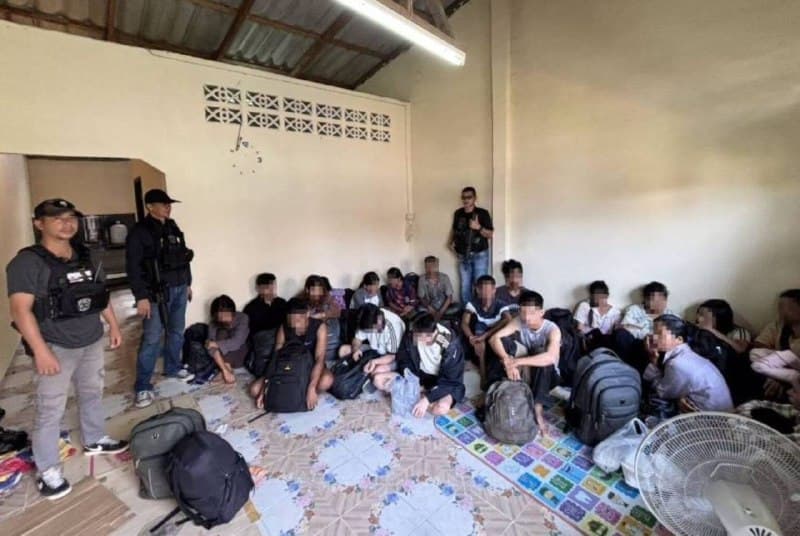
On October 11, acting on a tip from the public, Thai law enforcement worked with immigration and border patrol officers to arrest 21 foreign nationals in Buketa village, Waeng district, Narathiwat province. According to Thai police, the group was waiting at the Thai-Malaysian border for smugglers to lead them along mountain paths into Kelantan, Malaysia, where they intended to keep working at local scam operations.
The makeup of the group follows a familiar pattern. Four Chinese men in their forties were identified by police as senior members of an international fraud and human-trafficking ring. The other 17 were Myanmar nationals, including nine women, aged from their twenties to their thirties, described as low-level members. None of the 21 had valid travel documents.
Police also arrested a local Thai driver, who admitted transporting the group from Hat Yai to the border crossing point. In other words, the route from Hat Yai to the border and on to Kelantan relied on people handing the group along.
For Chinese communities across Southeast Asia, the case is a reminder of how these crews move: leaders relocate with their workers across borders, and when they are caught, everyone is undocumented and faces investigation for illegal entry, fraud and trafficking. All suspects are in Thai police custody, and the investigation is continuing.
Like for points, predict to win points|ToNanyang Prediction Market: https://tonanyang.cc/webapp/