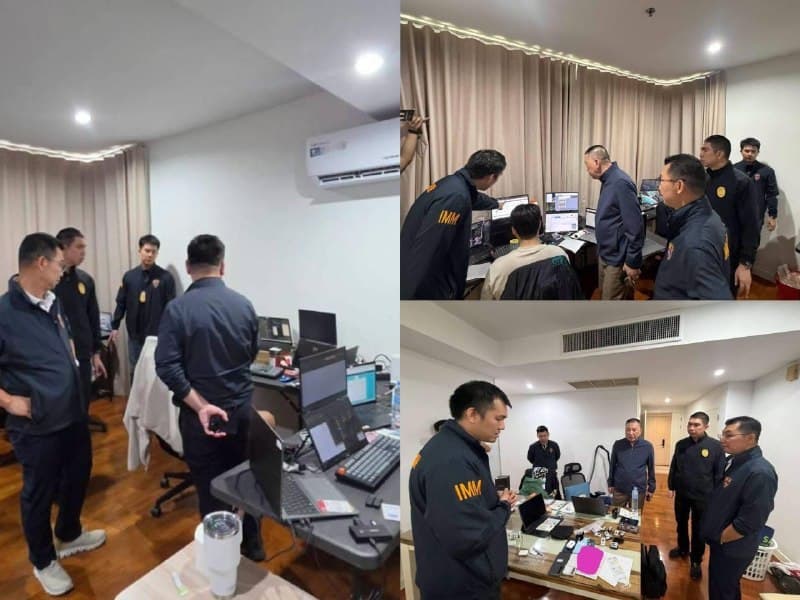

According to an official documentary released recently, during the 2024 Spring Festival, a high-rise building named 'Tianxia Fortune Entertainment Plaza Hotel' in Muse, Myanmar, was entirely occupied by telecom fraud gangs. The site was less than 200 meters in a straight line from the Jiegao border port in Ruili, Yunnan. Unlike the heavily fortified industrial parks in Kokang, syndicates in Muse operated discreetly, splitting into smaller cells scattered across local hotels, rented apartments, and private villas.
To bypass telecom crackdowns, these syndicates relied on sophisticated technical tricks. They installed wireless bridges, cables, and fiber-optic lines across the border, illicitly tapping into mainland China's domestic telecommunications infrastructure. This allowed outbound fraud calls and web traffic to disguise themselves as domestic lines, making detection and interception extremely difficult.
To neutralize this cross-border digital pipeline, China's Ministry of Industry and Information Technology dispatched over 100 industry experts to station along the Yunnan border. Working alongside police, they shut down 75,000 fraud-linked phone numbers in Muse, dismantled over 4,000 broadband accounts, and removed nearly 100 illegal wireless bridges in just three months, severing the syndicates' digital backbone.
Once the communication lines were severed, Chinese and Myanmar law enforcement moved in for ground sweeps. Joint operations in March and September 2024 rounded up 807 and 870 suspects respectively. A total of 665 Chinese nationals were transferred to Chinese custody, including nearly a hundred fugitives alongside 21 behind-the-scenes financiers and syndicate ringleaders.
From the dismantling of major fortified compounds to the surgical clearing of splinter cells along the borderline, the operational room for grey-market syndicates in Muse has effectively evaporated.
点赞送豆,预测赢豆|下南洋预测市场