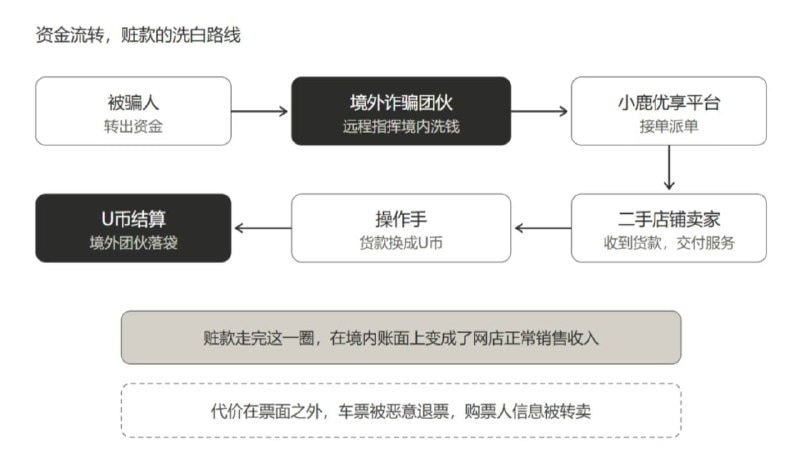
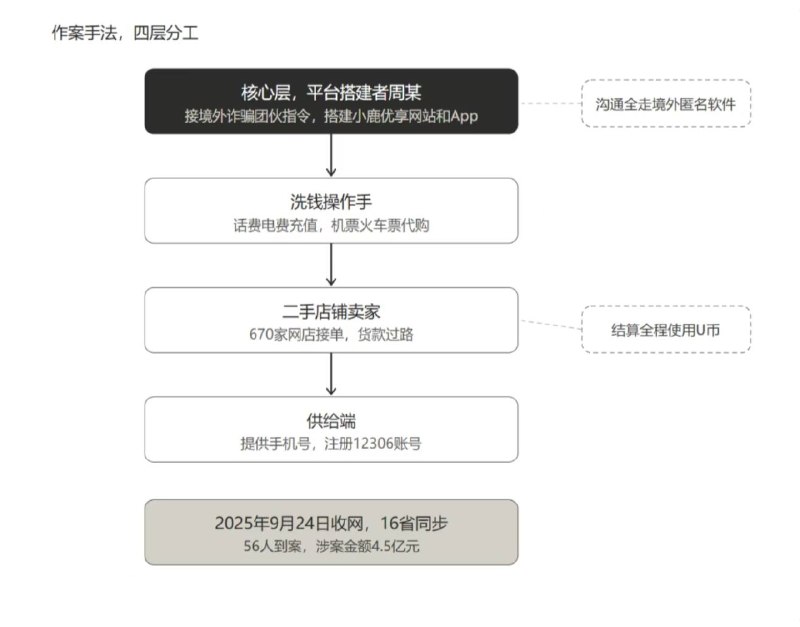

In March, the Hengyang Railway Transport Court handled a high-speed rail ticket and Tether scam case involving a staggering 450 million yuan, with 56 people caught in the dragnet. Last October, the mastermind, surnamed Zhou, hooked up online with an overseas scam syndicate and, following their instructions, set up a website and app called Xiaolu Youxiang. The platform started out helping people top up mobile phone credit and pay utility bills, but soon expanded to booking flight and train tickets. While the phone credit, electricity, and train tickets were all real, once scam victims' dirty money was funneled into these everyday transactions, it was laundered within just a few turns.
Ticket buyers had no idea their ticket money was tied to telecom fraud victims' accounts. The scam syndicate used stolen funds to buy train tickets at face value on 12306, while travelers paid discounted rates through second-hand online shops. The online shops took the travelers' cash and settled up with the overseas syndicate using virtual currency, looping the funds back to them. In the end, the overseas syndicate got their crypto, the travelers got their tickets, and the shops got their turnover. Everyone seemed to win, but dirty money had just been seamlessly laundered through ordinary consumption.
The whole loop was airtight, transforming abnormal transfers into train tickets, top-up receipts, and e-commerce turnover. With plenty of everyday users and legitimate merchants caught in the middle, police had to trace the trail step by step to figure out where the dirty money originally came from and where it ended up. Just like the various top-down and currency exchange spots you see on the streets here, money changing hands looks lively enough, but the water runs deep.