The Singapore Police Force and the Immigration & Checkpoints Authority (ICA) issued a joint statement on September 25: since January this year, at least 148 reports have been received involving scams related to ICA, with losses of at least S$8.8 million. The scams fall into 2 categories: one involves phone calls impersonating ICA officers to ask for money, and the other involves fake social media ads offering "PR application services."
First, the first category. Victims first receive an unfamiliar call. The caller claims to be from ICA and says your personal information has been stolen, or that your mobile number is linked to criminal activity, such as being used to send scam text messages. Before the caller is even done speaking, the call is "transferred" to another person, who impersonates a Chinese official and, in the name of an "investigation" or "bail," demands that the victim transfer money or hand over cash.
In some cases, the scammers also tell victims to meet strangers and sign fake documents such as confidentiality agreements, making the whole "investigation" look convincing. Police said most victims only realized they had been scammed after making several transfers, or when the scammers suddenly became unreachable. Since January this year, there have been at least 117 such phone scam cases involving impersonation of ICA officers, with losses of at least S$8.4 million.
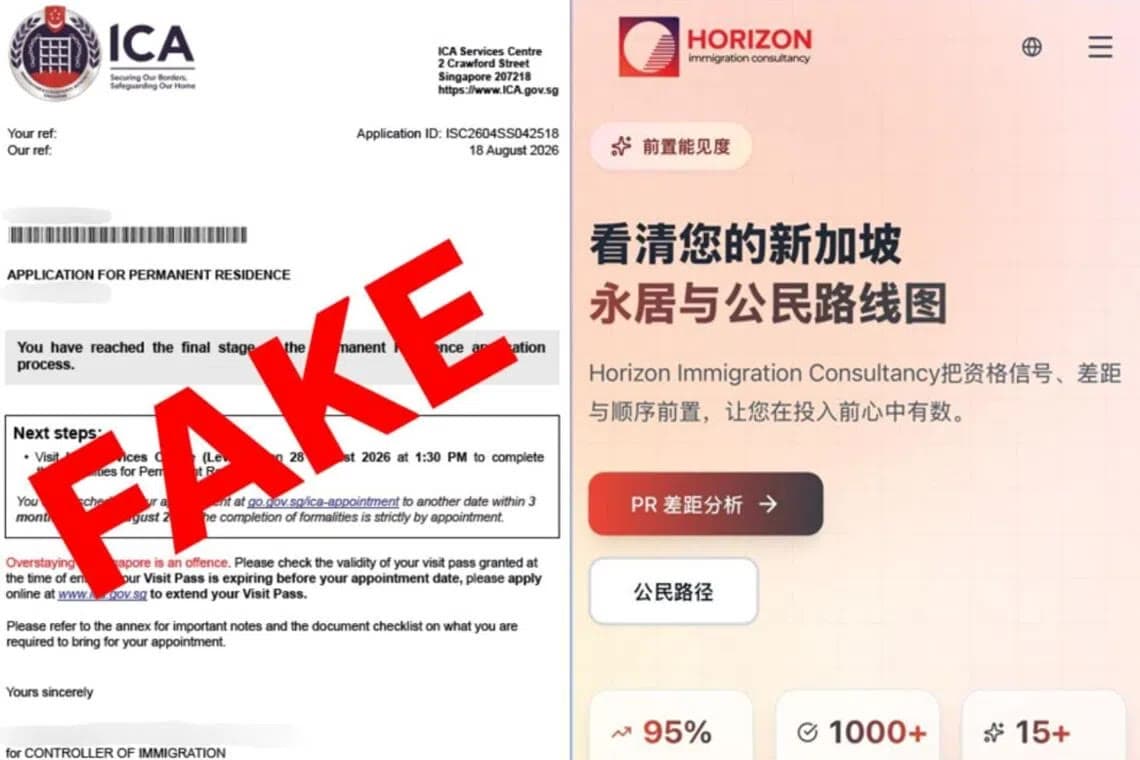
The second category is fake "PR application service" ads: people see ads on platforms such as Facebook, click through to the website of a fake consultancy company, fill in their details, and are then contacted by scammers via WhatsApp. The scammers collect fees ranging from S$200 to about S$90,000 on the pretext that investing in a company, purchasing educational certificates, or making donations can "raise the success rate," and finally send a fake In-Principle Approval (IPA) letter bearing ICA letterhead. ICA has received at least 31 related reports, with losses of at least S$400,000. The 62-year-old Malaysian woman previously reported by this site, who was cheated out of RM762,700 (about S$238,500), fell into this category.
For people working, accompanying their children to study, or doing business in Singapore, who has not had dealings with ICA? The moment they hear it is an "ICA call," they immediately tense up; when they then hear that their number is "involved in a case," they panic. That panic is exactly what the scammers want: once a person panics, they no longer stop to think, "Why would the immigration authority transfer the call to a Chinese official?" They only think about settling the matter as quickly as possible.
Scam-proof guide: how to spot phone scams impersonating ICA officers
1. How the scam traps people step by step
● Step 1, an unexpected call: the caller claims to be from ICA and says your personal information has been stolen, or that your mobile number is involved in criminal activity, such as sending scam text messages.
● Step 2, the call is "transferred" to another "official": the call is passed to an accomplice pretending to be a Chinese official, who makes the matter sound more and more serious.
● Step 3, they ask for money: in the name of an "investigation" or "bail," they demand that you transfer money or hand over cash.
● Step 4, complete the act: telling you to meet strangers and sign fake documents such as confidentiality agreements, so that you believe it even more firmly.
2. Hang up as soon as any of these signs appears
According to reminders from the Singapore police and the Immigration & Checkpoints Authority (ICA), Singapore government officials (including ICA officers) will never:
● Ask you to transfer money or hand over cash, luxury watches, gold, or cryptocurrency;
● Ask you to borrow money from licensed moneylenders;
● Ask you to disclose your online banking login details;
● Ask you to install mobile applications from unverified app stores;
● Transfer your call to the police or other government officials.
Also remember this: do not trust unsolicited calls and messages, even if the other party seems to know your personal information.
3. Official verification channels
● If you want to confirm whether a phone call or an email was really sent by ICA, you can check through the ICA Feedback Form on the ICA website, or call ICA at 6391 6100.
● For applications for all types of immigration passes, submit them directly to ICA through the ICA website. ICA said it does not support or recognize any commercial agency or consultant claiming to be able to improve the success rate of applications.
● Suspicious text messages, phone numbers and websites can be checked using the ScamShield app or the official website www.scamshield.gov.sg.
● Use the Infocomm Media Development Authority's (IMDA) SIMCardHowMany tool to check how many postpaid SIM cards are registered under your name; if the number does not match, inform your telecom company and the police immediately.
4. What to do if you have already transferred money
● Call your bank immediately and report the fraudulent transaction.
● Report the case to the police; if you are unsure, first call the 24-hour ScamShield hotline 1799 to ask.
● Install the ScamShield app, set transfer limits for online banking, and enable 2-factor authentication or multi-factor authentication.
● Tell your family and friends about the scam. If there are elderly people at home, make sure to explain in advance in particular: the real ICA will not call to ask you to pay "bail".
When living abroad, your documents are your confidence, so the moment you hear that there is a problem with your documents, it is especially easy to panic. But the more it is at a time like this, the more you should hang up first and check for yourself afterward: ICA's phone number and official website are right there, and spending 5 extra minutes verifying things is far easier than trying to recover the money after it has been transferred.