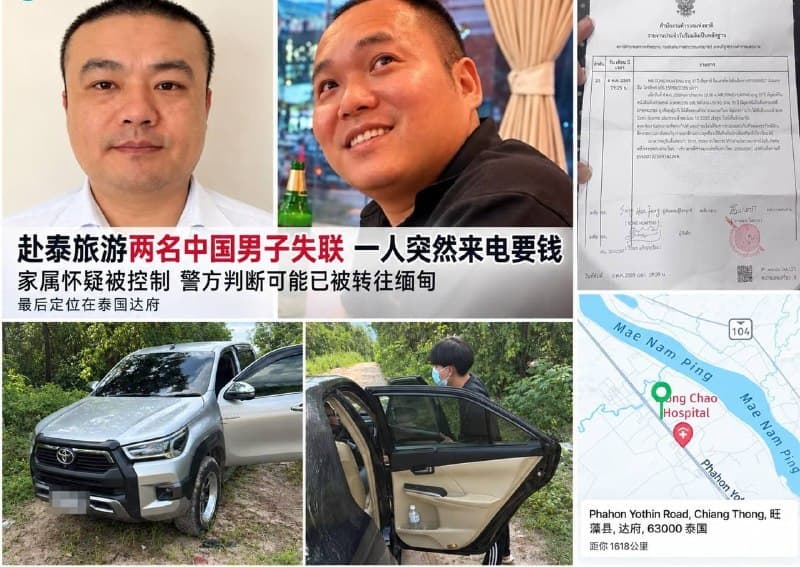
Thirty-eight-year-old Hu Xing and thirty-five-year-old Song Huating arrived in Bangkok on October 4 alongside Song's older brother. On October 6, while Song's brother stayed back at the hotel due to illness, Hu and Song went out together, switching vehicles along the way. Around 3 p.m., Hu sent a photo showing their vehicle parked near an isolated wooded area. Soon after, their phones went silent, with their last known GPS coordinates placed in Tak Province.
Thai authorities reviewed their route and concluded that the pair was likely smuggled across the border into Myanmar. Tak Province directly faces Myawaddy, home to some of the most notorious scam compounds in Southeast Asia. The overland corridor from Bangkok to the northwestern border has long been exploited by human trafficking networks, where crossing the river takes only a matter of minutes once a victim reaches the remote brush.
On October 9, the situation took a chilling turn. Hu unexpectedly called his family back home via WeChat, claiming that he and Song were together and telling them not to worry. He added that he was "fine inside and waiting to get out" while asking his family to wire living expenses. However, he refused to disclose his whereabouts, and Song was never allowed on the line, leaving relatives convinced that Hu was speaking under coercion.
The family has reported the incident to Thai police and sought assistance from Chinese embassies in both Thailand and Myanmar. For the Chinese community around the border, deceptive transit arrangements and fake pick-ups are familiar traps, and once someone is shuttled across that borderline river, getting them out becomes an uphill battle.
点赞送豆,预测赢豆|下南洋预测市场:https://tonanyang.cc/webapp/